


In the United States, drones are legally restricted to flying at a maximum altitude of 400 feet above ground level under FAA regulations. However, you can exceed this limit when flying near structures, staying within a 400-foot radius and up to 400 feet above the structure’s highest point. Commercial operators with Part 107 licenses can apply for special waivers through the FAA’s DroneZone website, while recreational pilots face stricter limitations. Breaking these rules could lead to hefty fines or even imprisonment!
Key Takeaways
- Drones are generally limited to flying at 400 feet above ground level in uncontrolled airspace.
- Commercial operators with Part 107 licenses can exceed 400 feet by getting special waivers from the FAA.
- Flights near structures can reach up to 400 feet above the structure’s highest point within a 400-foot radius.
- Recreational pilots face a strict 400-foot ceiling with fewer exceptions than commercial operators.
- Violating altitude restrictions can result in fines up to $75,000 and potential loss of pilot certification.
The 400-Foot Rule: Understanding Standard Altitude Restrictions
You may be interested
Are DJI Drones Banned?

Are Drones a Cause for Concern?

Are Drones Illegal? Understanding Drone Regulations
The single most important altitude restriction that every drone pilot must know is the 400-foot rule. This fundamental altitude standard, established by the FAA, limits drone operations to a maximum height of 400 feet above ground level (AGL) in uncontrolled airspace. Understanding these restriction definitions is essential for safe, legal flights!
The measurement always references the actual ground beneath your drone, not sea level. This clever regulation creates a buffer zone between drones and manned aircraft, which typically maintain altitudes above 500 feet. There is, however, one notable exception to remember: when flying near structures, pilots can exceed the 400-foot limit if they remain within a 400-foot radius of the structure itself. The FAA takes these limitations seriously, with potential fines for pilots who venture too high without proper authorization. Compliance with FAA certification requirements is also necessary for commercial drone operations.
Commercial vs. Recreational Drone Height Limitations

When it comes to legal altitude restrictions, commercial and recreational drone pilots face substantially different rules and limitations.
Commercial operators enjoy significant Commercial Advantages, with the ability to exceed the standard 400-foot ceiling under specific conditions. For instance, they can fly higher when remaining within 400 feet of structures or when granted special permissions for particular tasks. These professionals must demonstrate accredited skills and follow strict protocols, but the regulatory flexibility allows them to complete specialized missions!
In contrast, hobbyists face clear Recreational Constraints, with an absolute 400-foot ceiling—no exceptions! Unlike their commercial counterparts, recreational pilots cannot fly higher even near buildings or towers. They’re limited to uncontrolled airspace below this threshold, with zero opportunity for special permissions. The rules are simple: if you’re flying for fun, keep it under 400 feet, period. Additionally, many popular models like the DJI Mini 3 are designed to be lightweight and fall under the FAA registration exemption, simplifying compliance for recreational users.
Recommended Products

FAA Regulation Compliance: Holy Stone is committed to working out a solution to the US FAA Declaration of Compliance for our rc drone consumers; here we got the Remote ID Module Parts to solve the FAA Compliance issue. No more worry about the FAA Regulations.

𝗦𝗮𝗳𝗲 𝗖𝗵𝗮𝗿𝗴𝗲 𝗖𝗮𝗯𝗹𝗲: Without worrying about any charging safety hazards. The original type-c cable of Potensic remote id module has overcharge protection and will automatically stop charging when fully charged

Super Bright: VIFLY Strobe installs 5*3W Hi-intensity LEDs which provide the greatest range available for a mini strobe. 3+ Miles visibility that meets the FAA rules for night flying.
Flying Near Structures: When You Can Exceed 400 Feet

Despite the widespread 400-foot altitude ceiling, drone pilots can legally soar higher under specific circumstances when operating near structures! The FAA permits flights above 400 feet when operating within a 400-foot radius of a structure, allowing pilots to reach up to 400 feet above the structure’s highest point.
This valuable exception enables critical operations like tower inspections, building surveys, and power line maintenance. Height Measurement is calculated from ground level, not sea level, which gives pilots a clear reference point. Imagine inspecting a 600-foot cell tower – you could legally fly your drone up to 1,000 feet above ground level! The Structure Radius rule provides flexibility while maintaining safety, keeping drones visible and away from manned aircraft that typically fly above 500 feet in uncontrolled airspace. For precise operations near structures, using drones equipped with RTK technology ensures centimeter-level accuracy essential for detailed inspections.
Recommended Products
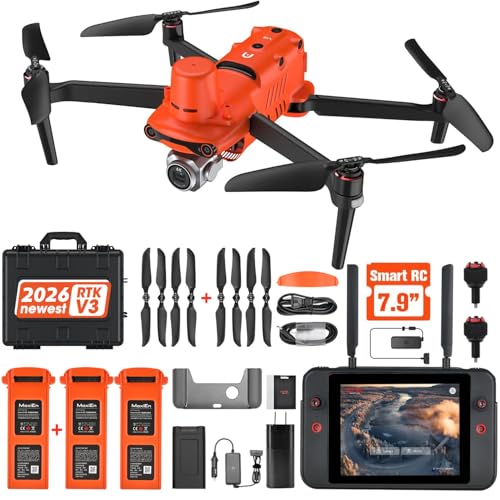
【AUTEL ROBOTICS USA AUTHORIZED】We are the longest and largest distributors of Autel Robotics. Over the years, we have maintained a close partnership with Autel, providing customers with high-quality products and excellent after-sales service. With extensive experience and strong technical expertise in the industry, we are able to offer customized solutions and professional technical support to our customers. All the U-A-V-S we offer include FULL USA WA-RRANTY.📣For ass.istance with packaging, accessories, usage, firmware updates, or any other issues, please rea.ch our te.ch su.pport team at 💌autelofficial @ outlook . com💌

🥇🥇🥇🥇🥇【100% AUTEL O.R.IGINAL】As an authorized Autel distributor, we source all products 100~% AUTEL O.R.IGINAL, directly from Autel's factory. This g.u~arantees a~uth.entic product quality and comprehensive a-fter-s-ales su.pp.ort. 📢Any issues, please re~ach📩AutelStoreOnline @ outlook . com📩

🥇🥇🥇🥇🥇【WHY CHOOSE US?】Every product we offer is sourced directly from Autel’s factory and is 100~% or.i.ginal. The Autel EVO 2 PRO Enterprise V3 sold here is not only covered by Autel Store’s af.ter-sa.les service, but also includes a U.S.-based war.ra.nty for timely and dedicated support.💝This bundle is backed by 30 Days REP~LACEMENT or F.U.LL R~E.FUND, 12 Months f-r.e.e from defects services. Any issues, please co.nt.act📩 AutelStoreOnline @ outlook . com📩
Obtaining Altitude Waivers for Special Operations

Professional drone pilots seeking to fly beyond standard altitude limits can pursue special permission through the FAA’s waiver system! Part 107-licensed operators can apply through the DroneZone website for operations exceeding the 400-foot ceiling. While there are no Waiver Fees associated with applications, pilots should plan ahead—the recommended Approval Timeline is 90 days!
Successful applications require thorough risk assessments and detailed operational plans. Applicants must demonstrate how they’ll maintain safety while conducting high-altitude missions for terrain surveys, infrastructure inspections, or aerial photography. The process isn’t just paperwork; it’s a thorough evaluation of your operational capabilities!
Recommended Products

You get 2 sets of 3 Labels, 1 FAA ID Card - All customized with your FAA information

2.5 inch metal Drone Pilot UAS Wings

【FAA Compliance】Easily meets FAA requirements for drones over 250 g (0.55 lb). This RID module replaces bulky add‑on RID units, enabling legal flight for Mavic 3, Mini 4 Pro, Phantom 4, ATOM 3‑Axis, HS720 series, FPV drones, and 20+ other models.
Airspace Classifications and Their Impact on Legal Flying Heights

Understanding airspace classifications is essential for every drone pilot who wants to stay legal and safe in the skies! The FAA divides our airspace into multiple classes that directly affect how high you can fly your drone.
Class G airspace is your drone’s best friend—it’s uncontrolled and typically allows flights up to 400 feet without special permission. However, when flying near airports in Classes B, C, D, or E, you’ll need authorization through the LAANC system. Don’t forget about Prohibited Zones and Special Use airspace, where drone operations may be severely restricted or completely banned! The good news? In Class G, you can fly higher than 400 feet if you’re within 400 feet of a structure—just don’t exceed 400 feet above its highest point. Always check airspace maps before takeoff!
Technical Altitude Capabilities vs. Legal Requirements

While many consumer drones can technically soar well beyond 1,000 feet into the sky, the legal reality keeps them firmly tethered to much lower altitudes! The FAA’s 400-foot ceiling exists for good reason—protecting aircraft and preventing accidents in shared airspace.
Modern drones often include built-in altitude restrictions that automatically comply with these regulations, even though their motors and propulsion systems could easily push them higher. At elevated heights, pilots must contend with significant challenges to Battery Efficiency, as thinner air requires more power to maintain lift. Additionally, Wind Resistance becomes a formidable obstacle, with stronger gusts threatening stability and control.
This gap between what’s possible and what’s permitted highlights the balance manufacturers strike—designing aircraft capable of impressive technical feats while implementing features that guarantee legal compliance for everyday users.
Recommended Products

【𝐔𝐩𝐠𝐫𝐚𝐝𝐞𝐝 𝐁𝐞𝐞𝐩𝐞𝐫 𝐅𝐞𝐚𝐭𝐮𝐫𝐞】The R111S drone remote id module includes a built-in beeper, making it easier to locate lost aircraft. This enhancement provides added convenience when retrieving your drone from challenging locations, adding another layer of safety and control to the flying experience.

FRONT & DESIGN ON BACK - FAA Licensed Quadcopter Drone Pilot
International Altitude Regulations for Drone Pilots

Handling drone regulations across borders presents a fascinating patchwork of rules that every drone pilot should know before taking flight! While most countries enforce the 400-foot (120-meter) altitude ceiling, regional variations create an interesting tapestry of Global Enforcement practices. The EU maintains standardized regulations through EASA, while North America follows FAA guidelines with similar height restrictions.
Some countries march to their own drum—Germany caps flights at 230 feet, France allows up to 492 feet, and Indonesia permits a generous 500-foot ceiling! These differences highlight the importance of researching destination regulations before packing your drone for international adventures. Cross Border Agreements continue to evolve as aviation authorities work toward more uniform standards, but until then, the savvy drone pilot must navigate this complex regulatory landscape with care and precision!
Safety Considerations When Flying at Maximum Legal Heights

Why risk your drone and potentially your safety when soaring near the 400-foot ceiling? Wind safety becomes increasingly critical as altitude increases, with strong gusts capable of whisking away even professional-grade equipment! Experienced pilots know to check weather forecasts and monitor real-time conditions before attempting flights near maximum legal heights.
Sensor maintenance is non-negotiable for high-altitude operations. Your drone’s barometric sensors and GPS systems must be properly calibrated to provide accurate altitude readings, especially when you’re pushing the 400-foot limit. Remember, that safety buffer between your drone and potential manned aircraft is only 100 feet—not much room for error! Advanced obstacle avoidance systems can help, but they’re no substitute for a well-trained pilot who understands the risks of high-altitude flying and maintains visual line-of-sight at all times.
Recommended Products

【Obstacle Avoidance】: SU04 is a transmitting and receiving hybrid ultrasonic sensor, it will help helicopter, multirotor, airplane, car, and boat achieve autonomous obstacle avoidance in 8 directions horizontal, obstacle avoidance to the upward side and altitude hold to the downward.

【2K HD Camera & 5G Real-time Transmission 】The 2K drone is equipped with a 90° electrically adjustable camera, enabling effortless adjustment of the camera angle for enhanced perspectives. Built-in shock absorption and 5GHz FPV transmission ensures smooth and stable videos. Also easily share the happy moments stored on your phone or SD card to your social media platforms.

【High-precision airspeed measurement】Professional-grade drone airspeed sensor ✔ 0-100m/s (224mph) accurate measurement range, providing real-time space-speed data for fixed-wing drones and FPVs ✔ Digital pitot tube design, more stable than traditional analog sensors, with strong anti-interference ✔ ±0.5m/s high precision, ensuring the reliability of autonomous flight modes (such as cruise, return)
Consequences of Violating Drone Altitude Restrictions

Violating drone altitude restrictions can result in severe consequences that extend far beyond a simple warning! The penalty severity for exceeding the 400-foot ceiling without proper authorization is quite substantial, with civil fines reaching a whopping $75,000 per violation. Imagine losing your Remote Pilot Certificate after working so hard to obtain it!
The ramifications impact both recreational and commercial pilots, as the FAA doesn’t play around when it comes to airspace safety. Criminal penalties can hit your wallet with up to $250,000 in fines and, yes, you might even face up to three years behind bars for particularly reckless violations. Your beloved drone could be confiscated on the spot, and you might find yourself banned from flying altogether. Those sky-high adventures suddenly seem less appealing, don’t they?
Frequently Asked Questions
Do Weather Conditions Affect Legal Flying Altitude Limits?
While storm regulations remain unchanged, weather conditions ironically limit flying heights in practice. Fog variations create visibility challenges, requiring operators to adjust altitudes below technical maximums despite legal limits staying constant regardless of weather.
How Do Drone Altitude Restrictions Apply Over Water?
Drone altitude restrictions over water remain at 400 feet AGL under FAA regulations. Water altitudes follow the same guidelines as land operations, with no special marine regulations providing exemptions for flying higher over aquatic environments.
Can Drones Detect Approaching Aircraft to Avoid Altitude Violations?
Like eagles scanning for threats, modern drones equipped with Aircraft Detection and Avoidance Technology can identify approaching aircraft, allowing them to automatically adjust their position to maintain safe distances and prevent altitude violations.
Are Altitude Restrictions Different for Indoor Drone Flights?
Indoor drone flights aren’t subject to FAA’s 400-foot altitude restrictions. Instead, altitude considerations focus on Indoor Safety practices, with pilots typically maintaining positions midway between floor and Ceiling Heights to guarantee best control and collision avoidance.
Do Mini or Toy Drones Have Different Altitude Restrictions?
Mini and toy drones face the same 400-foot legal altitude restriction as larger models. Despite their technical limitations, no Mini Variances or Toy Exemptions exist in FAA regulations regarding maximum flying height for recreational use.


